
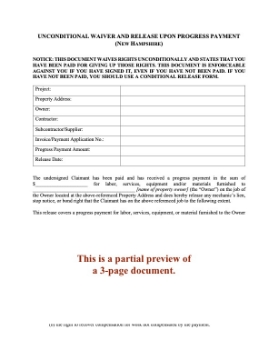
New Hampshire Unconditional Lien Waiver and Release on Progress Payment
New Hampshire contractors, release your lien rights up to the date of a progress payment with this Unconditional Waiver and Release of Lien form.
- The Waiver and Release authorizes a full and complete release of any lien rights or claims for payment which the contractor may have against the owner's property.
- The release will be provided to the owner upon receipt of confirmation that the contractor has received the progress payment.
- This template is provided in MS Word format, and is easy to download, fill in and print. Buy the form once, and it's yours to use as often as you require.
- Intended to be used only in the State of New Hampshire.
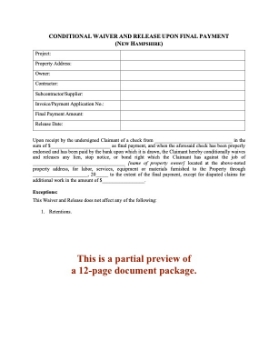
New Hampshire Lien Waiver and Release Forms Package
New Hampshire contractors, prepare your lien releases quickly and easily with this package of downloadable Lien Waiver and Release Forms.
State Law Governing Lien Waivers
New Hampshire law does not mandate specific statutory forms for lien waivers. Both conditional and unconditional lien waivers are alowed.
State law does allow a party to waive its lien rights in the contract before work commences, and does not specifically prohibit waiving lien rights prior to payment.
What is Included in the Package
This package contains the following forms which allow you to partially or fully release your lien claim against an owner's property, as payment is received:
- Conditional Waiver and Release of Lien Upon Progress Payment,
- Unconditional Waiver and Release of Lien Upon Progress Payment,
- Conditional Waiver and Release of Lien Upon Final Payment, and
- Unconditional Waiver and Release of Lien Upon Final Payment.
Format and Jurisdiction
Save money by buying the package of forms instead of purchasing them individually. These MS Word documents are customizable and reusable so they can be used on all your work projects.
The New Hampshire Lien Waiver and Release Forms are prepared in accordance with State laws and should only be used on projects within that State.