You Don't Always Need a Lawyer.
Businesses and individuals regularly need legal documents for everyday transactions.
Your personal and professional life may require you to prepare leases and rental agreements, supply and service contracts, a will, a power of attorney, real estate contracts, lien forms — the list is long and varied.
It's not always necessary to hire a lawyer to prepare every document, but some situations require legal advice, careful drafting, or professional review.
How do you know when to use a legal template and when to hire a lawyer?
Ask yourself this question: Is the document relatively straightforward, or does the situation involve significant risks or complicated circumstances that may require legal advice?
The right approach depends on several factors:
- the structure of the document (i.e., how complicated is it)
- the circumstances
- the potential consequences of making a mistake
- the user's level of sophistication (i.e., the ability to understand and complete the document correctly).
If you're able to comprehend the terms and conditions of the document, then you can most likely do a great deal of the drafting yourself. If not, then you should retain a legal professional to do the heavy lifting.
What Is a Legal Document Template?
A legal document template is a pre-drafted document intended to be used for a particular purpose, which can be customized by the user to fit their specific circumstances.
You may not know this, but lawyers have been using document templates for decades. Every lawyer has what's called a "precedent system" — a library of essential legal document templates that they have developed for their clients. They don't write leases or commercial contracts from scratch — they simply choose the template they need from their precedents and revise it for the current client.
Common examples of legal document templates include:
- Residential lease agreements
- Independent contractor agreements
- Confidentiality and non-disclosure agreements
- Business purchase and sale agreements
- Wills and estate planning documents
- Powers of attorney
- Promissory notes.
A document template typically will contain:
- contractual provisions required for the specific type of transaction and the laws of the jurisdiction in which the transaction is being conducted,
- standard provisions (boilerplate) that are common to most commercial contracts (such as governing law, severability, amendments, giving of notices),
- blank fields where the user's details and particulars will be entered,
- instructions and notes to help the user complete the document.
What is the difference between a customizable legal template and a generic "free" form downloaded from an unverified website?
Our customizable legal templates have been prepared by legal professionals who are experienced in drafting legal contracts.
With the exception of statutory government-generated forms, so-called "free" legal templates are not as free as you might think. One-size-fits-all does not work when it comes to legal documents.
- Jurisdiction. A document intended for use in one province, state, or country may not be appropriate elsewhere — each jurisdiction has its own laws, rules and regulations which must be complied with.
- Incomplete Provisions. Download one of those free forms and read through it. Are there provisions for limitation of liability, indemnification, confidentiality, terminating the agreement, resolving disputes? There are many legalities that must be addressed (many of which are specific to the transaction), and if you're not familiar with those requirements you won't notice that they're not there.
- Legal Requirements. Do you know what the legal requirements for proper execution of a document are in your jurisdiction? If you're preparing a power of attorney, an advance healthcare directive, a real estate transfer, a will — many other types of documents — there are almost always statutory requirements for executing those documents. If they are NOT properly witnessed and signed, they are NOT legally valid.
Can you guarantee that every legal document template is legally valid?
No. No one could make that guarantee. Laws change, and interpretation of the law is a big part of determining the validity of the completed document.
A legal document template provides you with a starting point, a means of drafting a contract that will save you time and money — it's a convenience, not a guarantee. If you want to ensure that your contract will be legally effective in every situation, you should have it reviewed by a lawyer.
When should you use a legal document template?
There are a number of scenarios in which using a document template is a reasonable choice. These include standardized routine transactions, low-risk situations, preliminary discussions (a perfect example for a letter of intent), uncontested arrangements, and straightforward arrangements.
1. When the transaction is straightforward
Well-drafted legal templates may be suitable when all parties understand the transaction and their respective rights and obligations.
Good examples:
- A standard residential tenancy agreement — these are generally highly regulated by state / provincial / territorial laws, so it is relatively easy to prepare a document that complies with all regulations.
- A basic confidentiality agreement.
- A simple promissory note.
- A bill of sale.
2. When the document follows a familiar, established format
Many common legal transactions involve provisions that are relatively predictable. A professionally prepared template can provide a convenient way of documenting those arrangements by reusing a template contract with standard terms and provisions, which can be customized as required for each usage.
Examples of this include:
- Consistent administrative work, such as preparation of corporate minutes and resolutions
- Straightforward documents such as travel consent letters for minors, or basic powers of attorney.
- Property management forms.
3. When you understand what the document does
Users should be able to comprehend and explain to others:
- What the document is intended to accomplish.
- Who the parties are.
- What obligations each party is accepting.
- What happens if someone defaults in the performance of their obligations.
- When the agreement begins and ends.
- What the risks are to each party if another party fails to comply.
If you do not understand the legal effect of important provisions of the document, professional assistance may be appropriate.
4. When you need an affordable, practical solution
The two main reasons people and businesses use legal document templates are (1) to save money, and (2) for convenience. It's much easier to turn to a template when you need to prepare a document than it is to book an appointment with your lawyer, go through the drafting process, and then pay the bill for legal fees.
Our Document Templates are particularly useful for entrepreneurs, individuals, landlords and property managers, and small businesses that regularly need standardized legal forms and are operating on a budget.
5. When the document will be used repeatedly
Examples include:
- Businesses hiring independent contractors.
- Landlords and property managers preparing "cookie-cutter" tenancy agreements.
- Contractors filing lien forms.
- Businesses entering into routine service agreements.
- Employers preparing standard workplace documents (office manuals, policy statements, etc).
Reusable template forms can improve consistency and reduce repetitive administrative work. But they should be reviewed and updated periodically, as your business grows and evolves and whenever applicable laws change.
Things to Keep in Mind When Using Legal Document Templates
Be prepared to spend some time when using a template form. You must complete all required fields, select the appropriate provisions, and read, review and ensure you understand the final document before signing.
A template should not simply be downloaded and signed without being read and understood. If you have any questions or concerns, consult a lawyer.
REMEMBER: Legal document templates are not intended to replace legal counsel.
When should you consider hiring a lawyer to draft your document?
There are certain circumstances where professional legal assistance may be necessary or desirable when you are drafting contracts.
1. When the transaction is complex or involves substantial financial risk
A template may not adequately address a complicated negotiation. A lawyer can help identify risks, negotiate terms, and explain the consequences of accepting particular obligations.
Complex or highly risky transactions include:
- Buying or selling a business.
- Purchasing commercial real estate.
- Entering into a complicated partnership arrangement.
- Negotiating a high-level commercial contract.
- Arranging for substantial loan financing.
- Entering into a transaction involving significant liabilities.
In any of these situations, or in any other complicated contractual relationship, what may seem like a relatively small drafting error can have substantial financial and legal consequences.
2. When the parties have conflicting interests
- Insurance Provider and Insured: The insurance company wants to collect high premiums and pay out as little as possible on claims to maximize profit. The insured person wants to pay the lowest possible premium and receive maximum payout when filing a claim.
- Employer and Employee: The employer wants maximum output, longer hours, and lower wages to reduce operational costs. The employee wants the highest possible salary, better benefits, and fewer working hours.
- Buyer and Seller in a Transaction: The buyer wants the lowest price and highest quality for goods or services. The seller wants the highest price and lowest production cost to maximize their profit margin.
- Lender and Borrower: The lender (creditor) wants a high interest rate and strict repayment terms to secure a high return and mitigate risk. The borrower wants a low interest rate and flexible, easy repayment terms.
- Landlord and Tenant: The landlord wants to charge the highest possible rent and pass on maintenance costs where possible. The tenant wants affordable rent and expects the landlord to cover all repair and upgrade expenses.
3. When the document involves unusual or complicated circumstances
Examples of this could include:
- A business acquisition involving multiple owners with different ownership interests.
- A family estate involving competing claims.
- A commercial lease with unusual conditions.
- A contract to be performed in more than one jurisdiction (such as an international distribution agreement).
- An agreement involving intellectual property ownership or licensing.
4. When you are uncertain about your legal rights or obligations
You must be certain in your own mind whether a particular business relationship or transaction is legally advisable for you to undertake. A lawyer can explain applicable laws, legal options, potential liabilities, and the consequences of different decisions.
5. When the law requires specific procedures or formalities
There are certain documents which require particular wording, witnessing, notarization, registration, independent legal advice, or other formalities. These requirements vary by jurisdiction and document type.
- Many real estate title deeds and transfers require either witnesses or notarization, or both.
- Wills, powers of attorney, and advance directives usually must be signed in the presence of two or more witnesses, and there may also be requirements for at least one witness to swear an affidavit as well.
- In some jurisdictions, a personal guarantee may require a specific form of certificate to be signed in front of a lawyer or notary.
- Domestic contracts — marriage and separation agreements, for example — often require the parties to obtain independent legal advice prior to signing, in order for the contract to be legally valid.
- Corporate filings — incorporation, amalgamation, dissolution — require approval by proincipals and shareholders, and must then be registered with the appropriate registries.
5. When a dispute already exists or legal proceedings are involved
A document template is NOT a substitute for legal advice. This is especially true when:
- A party has breached an agreement.
- A lawsuit has been threatened or commenced.
- A tenant or landlord is involved in a serious dispute.
- A business is facing a significant contractual claim.
- A person is responding to a legal demand or court proceeding.
Only a lawyer can assess the available remedies, applicable deadlines, and potential consequences of any such circumstance.
Using Legal Templates vs. Hiring a Lawyer: A Practical Comparison
The table below compares using templates vs. obtaining legal advice, and sets out the pros and cons of each option.
Legal document template | Hiring a lawyer |
Generally lower upfront cost | Usually higher costs |
Buyer customizes an existing document | Lawyer prepares, reviews, or revises documents |
Often available for immediate download | May require appointments and additional time |
Based on the form's structure and available options | Can be tailored to individual circumstances |
Does not provide individualized legal advice | Can provide advice about rights, obligations, and risks |
Best suited to relatively straightforward transactions | Useful for complex or unusual transactions |
Depends on the user's understanding and review | Lawyer can identify and assess legal risks |
The Middle Ground: Use a Template and Have a Lawyer Review It
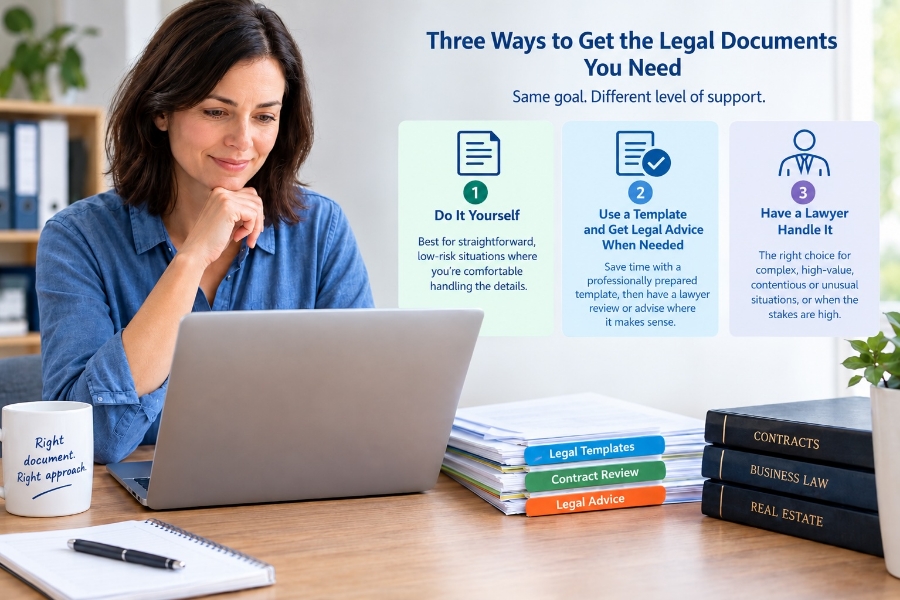
These two approaches are not mutually exclusive. You can purchase a template and then pay a lawyer to review it. A legal template can reduce the amount of time a lawyer needs to spend preparing a document, without eliminating the value of having a lawyer involved if and when legal advice is needed.
Evaluate the specific document and circumstances involved, rather than automatically assuming that every legal document requires a lawyer or that every document template is sufficient.
Ensure that the lawyer reviewing it is aware that the document you are working from is a template and explain to them how you intend to use it.
A legal document template can provide the initial structure and content of a document. A lawyer can review the document for potential issues, missing provisions, and suitability for the transaction.
You can use the template to prepare the basics of the contract before seeking professional advice. The lawyer can then revise only the provisions requiring attention, rather than preparing an entirely new document.
The value of the professional review depends on quality of the original document template, the complexity of the transaction, and the lawyer's scope of work.
Find out about our contract review services for Canadian customers.
Conclusion: Choose the Approach That Best Fits Your Situation
Using a template and obtaining legal review are complementary options rather than competing choices.
For straightforward transactions, a professionally prepared legal document template may provide a practical starting point. When the circumstances are complex or the consequences of a mistake could be substantial, consulting a lawyer can help you make a more informed decision.
The goal is not simply to prepare a legal document as cheaply or quickly as possible. It is to end up with a document that accurately reflects the parties' intentions, meets applicable legal requirements and provides an appropriate level of protection to all involved.
A template is a document-preparation tool. A lawyer provides legal advice. They perform different functions and can work very effectively together. Legal document templates are not intended to be a substitute for legal advice.
We have already done much of the drafting work for you. Use our legal document templates yourself where appropriate, or take the document to your lawyer and let them build on it.
Frequently Asked Questions
Are legal document templates legally binding?
The use of a template alone does not guarantee enforceability, but if the document is properly completed and executed, it will create a valid and binding agreement provided that it satisfies the applicable legal requirements.
Is it legal to write your own contract without a lawyer?
In many situations, individuals and businesses can prepare their own contracts. However, certain transactions have specific legal requirements, and professional advice may be appropriate.
Should I have a lawyer review any contract I create from a legal document template?
A lawyer's review may be advisable if the transaction involves substantial risk, unusual provisions, or uncertainty about the parties' legal obligations. Not every routine document requires individual legal review.
Can I modify a legal document template myself?
Templates are generally intended to be customized, but be careful what type of changes you make. Altering legal clauses without understanding their effects can introduce unintended risks. Users should understand the provisions they change and seek advice where necessary.
Can I use a free legal document template?
Remember the old saying — "You get what you pay for." Free templates may be useful starting points, but users should check their source, accuracy, completeness, jurisdiction and currency. Most free templates are generic, simple, basic documents and may not contain all of the necessary terms and conditions.
What if the other party wants to change the terms of my template?
Review the proposed amendments carefully. Consider whether they change the allocation of responsibility, financial obligations, remedies, risk factors or other important rights. If you are uncertain about the effect of the changes, consult a lawyer before signing.