
Succession Planning
Protect the future of your small business after your retirement, disability or death by putting a Business Succession Plan in place.

If you have a small single-owner or family-owned business, you should ask yourself the following questions:
- What will happen to your business when you are no longer able - or willing - to run it?
- Will the business be sold? If so, how will you determine the fair market value?
- Do you plan to hand it your business over to your kids? Do they have any desire to run the business?
- If not a family member, who else might potentially be able to take over the operations?
- How would a sale of the business affect your personal tax liability?
- When are you planning to retire?
The answers to these questions will act as a framework for your succession planning.
What is a business succession plan?
A business succession plan is a strategy and a series of procedures that makes provisions for transitioning your business if and when you decide to retire, or if something unexpected — like death or illness — occurs.
Succession planning is essential for ensuring continuity for the business, creating a buffer zone to help deal with unexpected events, and providing financial security for the owners.
Why is a business succession plan important?
BMO Financial Group points out that a majority of small business owners "do not have a formal plan to exit their business or preserve the continuity of the business upon retirement."
A well-thought-out business succession plan can help you:
- Provide continuity for operation of your business during a sale or transfer of the business or through unexpected events such as disability, serious illness, or death of the owner.
- Ensure a smooth transition with a minimum of disruption for employees and customers.
- Provide training for the new owners and management.
- Provide a formula to determine the value of the business, identify potential buyers or buyer classes, and deciding when is the best time to sell.
- If there is no clear successor and selling is not feasible, provide a clear path for winding down the business, notifying customers, and closing the operations.
Find forms and information to help you sell your business.
Who can use these Succession Planning Forms?
Every small business which would be significantly impacted by the death, disability or retirement of an owner should have a succession plan, especially if there is no clear successor to take over managing and operating your business.
Why use our Business Succession Planning Forms?
- Instant digital downloads
- Easy-to-edit and reusable templates
- Suitable for small businesses and entrepreneurs
- Saves time and legal drafting costs
- Generic and country-specific forms available
Additional Information
The importance of succession planning
Business succession planning for the entrepreneur
Succession planning: Keeping it in the family
Succession planning can help your small business transition to new ownership
What will happen to your business when you can no longer run it?
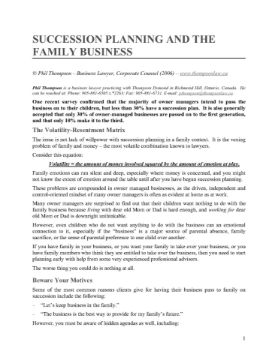
Succession Planning and the Family Business
Every family business should have a succession plan in place.
This article will help you identify the issues to consider when planning your succession plan / exit strategy so that you can retire and pass on your business to the next generation.
Why does a family business need a succession plan?
This article by the Harvard Business Review discusses the reasons why family business owners need to design a transition plan to avoid tension, discord and disruption to business operations.
Topics Discussed
The topics covered in "Succession Planning and the Family Business" include:
- Examining the reasons for leaving the business to a specific family member.
- The most common mistakes in crafting a family-based succession plan.
- Determining what is best for succeeding generations.
- Tips for creating a successful succession plan.
Author Credit
This expert guide was written by Phil Thompson, business lawyer and corporate counsel in Ontario, Canada.

Top 10 Tips to a Winning Exit Strategy
Learn the Top 10 Tips to a Winning Exit Strategy with this 8-page article written by an expert business lawyer.
- The aim of the article is to help small business owner-managers prepare a succession plan to ensure that their businesses continue to thrive after their departure.
- These top 10 tips can help you put together a successful exit strategy that not only addresses your personal needs, but is also in the best interests of the business.
- The author is an Ontario lawyer whose main focus is small businesses.
- Available as a PDF download.