Setoff and Cancellation Agreement | Canada
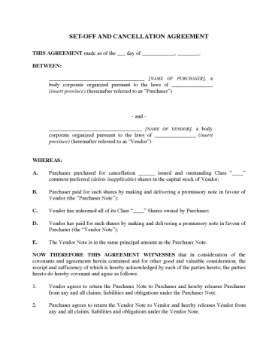
Prepare an Agreement for Set-off and Cancellation of Shares between two affiliated Canadian companies with this downloadable template.
- One of the companies (selling company) sells shares to the other (purchasing company), as part of a rollover transaction.
- The purchase price of the shares is set off against the redemption of shares of stock held by the purchasing company in the capital of the selling company.
- The purchaser pays for the shares by way of a promissory note. The vendor redeems the shares and pays the redemption price also by way of promissory note.
- Both promissory notes are for the same amount and set each other off.
- This legal template is available in MS Word format, and is fully editable to fit your specific circumstances.
- This is a Canadian legal document pursuant to the Income Tax Act (Canada).
Directors Resolutions Redeeming Shares | Canada
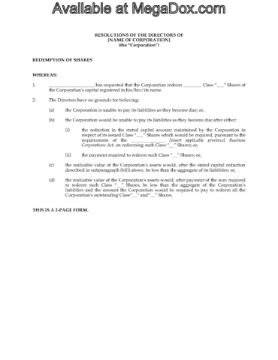
Before a Canadian corporation can redeem any of its issued shares, the action must be authorized by a Resolution of the Directors.
- Use this easy downloadable template to prepare the Resolution form.
- By passing the Resolution, the Board of Directors authorizes the redemption of shares from a shareholder.
- The shares will be redeemed provided that the corporation determines that redeeming the shares would not render the corporation unable to meet its liabilities.
- A resolution for redemption of shares also requires the consent of the shareholders.
- This corporate template can be used by federal corporations and by any provincial corporation which was formed under a Business Corporations Act. A French language translation is required for use in Quebec.
Short Form Stock Redemption Agreement | USA
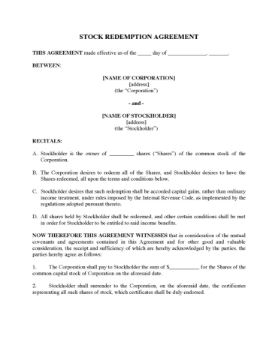
Use this downloadable short form Stock Redemption Agreement template to redeem shares in a U.S. business corporation.
The Stock Redemption Agreement outlines the terms under which the corporation will buy back shares from a specific stockholder.
Redemption of Shares
Under this agreement, the corporation consents to redeem all of the shares currently held by the designated stockholder. This process effectively removes the stockholder’s ownership interest in the company.
Tax Treatment
The redemption is structured so that the transaction will be treated as capital gains rather than ordinary income for tax purposes.
Stockholder Resignation
As part of the agreement, the stockholder will resign from any positions held as director and officer of the corporation upon the completion of the redemption.
Restriction on Future Stock Acquisition
The stockholder further agrees not to acquire additional shares of the corporation's stock for a specified period following redemption.
Format and Intended Use
This agreement is available in Microsoft Word format and is intended exclusively for use within the United States.
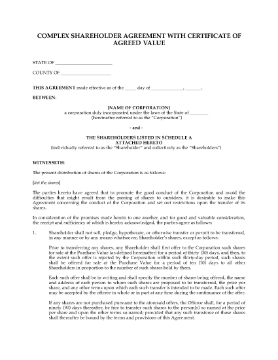
Shareholder Agreement with Certificate of Agreed Value | USA
Set restrictions on transfers of shares in a U.S. corporation with this Shareholder Agreement, with a Certificate of Agreed Value.
- Before offering shares to any other party, a shareholder must first offer them to the corporation.
- The corporation is obligated to purchase a shareholder's shares if the holder dies or becomes incapacitated, bankrupt, makes an assignment for the benefit of creditors, or if the shares are attached.
- The purchase value of the shares is determined by a certificate of agreed value signed by all of the shareholders and filed with the corporation.
- If the certificate of agreed value is older than 2 years, the book value of the shares will be used, as determined by the corporation's accountants.
- The USA Shareholder Agreement with Certificate of Agreed Value is a digital download that you can easily customize to fit your exact requirements.
Assignment and Transfer of Stock Certificate | USA
Authorize the transfer of shares of stock from a seller to a buyer with this Assignment and Transfer of Stock Certificate form for U.S. companies.
- The transfer form would accompany a share purchase agreement, to document a sale of shares.
- The form can be used by companies throughout the United States.
- The seller of the shares appoints an officer of the corporation as his/her attorney to transfer the stock on the corporation's books.
- To get the form, click on 'Add to Cart', purchase the form via the secure checkout, and download it.
- Available in MS Word format.
- Intended to be used only within the United States.
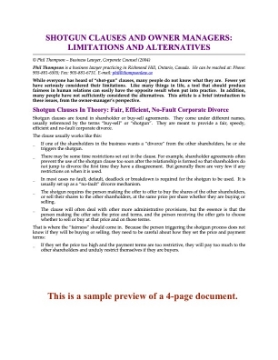
Shotgun Clauses and Owner Managers
Should your company shareholder agreement include a shotgun clause? This article discusses these types of provisions from an owner-manager's perspective.
What is a "shotgun clause"?
A 'shotgun clause' or 'buy-sell clause' is a clause in a shareholder agreement which provides that if a shareholder wants to pull their investment out of the company, they can force the other shareholders to buy their shares.
Benefits and risks of a shotgun provision
The selling shareholder sets the price and the terms of sale, and the remaining shareholder(s) decide whether to accept the sale on that basis. In theory, a shotgun clause provides a fair mechanism for shareholder departure, due to the fact that the seller does not know whether or not the price and terms will be accepted. Therefore they must be reasonable in setting the price and terms.
In practice, however, a selling shareholder often tries to use the shotgun clause to their advantage, which can result in the receiving shareholder(s) turning to arbitration or the courts to settle the matter.
Practical limitations of shotgun clauses
The article discusses the limitations on shotgun clauses, and how to use them properly in your shareholder agreement.
Alternative methods of shareholder breakups
The writer discusses other methods of no-fault corporate divorce that can be used instead of a shotgun provision, such as drag-along, tag-along clauses, right of first refusal options, and auction or bidding processes.
Author Credit
This article was written by Phil Thompson, business lawyer and corporate counsel in Ontario, Canada.

Shareholder Minutes of Annual Meeting | USA
Prepare the minutes from an annual meeting of the shareholders of a USA business corporation with this downloadable template.
Purpose of Minutes
The corporation's shareholders must meet each year to elect the directors for the coming year and conduct any other business that needs to be dealt with at the annual meeting.
Format
The Shareholders Minutes are available in MS Word format and are fully editable. You can use this template to prepare the standard form of minutes, and re-use the form each year.
Where to Use the Form
This template is intended to be used only by companies incorporated in the United States. It can be used in any state that does not have a statutory form.
Proxy Forms for Shareholder Meetings | USA
Prepare Proxy Forms for meetings of the shareholders of a USA corporation with these two easy-to-use templates.
- Revocable Proxy, to be used by a voting shareholder to appoint a proxy to vote the shares on his / her behalf at all meetings that the shareholder is entitled to attend. The shareholder has the right to revoke the proxy at any time.
- Non-Revocable Proxy, which contains a termination date. The proxy is irrevocable until the date of termination. The shareholder's shares must carry a legend stating the existence of the proxy, and that all rights under the proxy will survive any transfer of the shares.
These Proxy Forms can be used for shareholder meetings of U.S. business corporations. Available in MS Word format. Fully editable and reusable.